Breaking down MetaHarness, the system behind Tenex's SDLC, the principles it runs on, and what changes when coding agents become partners in development.
“On days where everything works well, I can’t help but think nothing I do matters, everything is automated and better and faster than I ever will be. But then there are days where everything breaks and I don’t understand why and I realize I have no idea what I’ve been up to anymore.”
The anonymous Anthropic engineer put words to something we’ve all felt since the release of Sonnet 3.5. The defining risk of agentic software development is that execution can now scale faster than the systems engineers use to preserve context, coherence, and understanding.
But coding agents do not have to make software development less legible. Paired with a process designed for human-agent collaboration, they make possible an SDLC that is faster, more robust, more repeatable, and better documented than what came before.
This essay describes the principles & process behind MetaHarnessThe set of conventions and workflows around Tenex’s AI-native SDLC., the system that runs Tenex’s AI-native SDLC, & how you can deploy a similar system within your engineering org.
The evolution of SDLC
The development process is a dance between collaboration and coherence. And as technology has evolved, so too has the manner in which engineering teams work together to keep a system coherent.
Waterfall tried to make software predictable by proactively mapping an entire system. Winston Royce published the cascade diagram in 1970. In the same paper, he warned that building this way “is risky and invites failure.” The industry kept the diagram and dropped the warning. Unknown unknowns are a property of software, and a process that depends on predicting the future is highly fragile.
The Agile Manifesto was the practical response, written in 2001 by seventeen developers at a ski lodge in Snowbird, Utah. Instead of pretending the team could know everything at the start, it organized work into small increments and relied on frequent conversation. An engineering org carried a surprising amount of context through standups, pairing, reviews, and the collective memory of a group building for 12 hours a day together.
That is the part agents change. An engineer remembers yesterday’s huddle, notices that a ticketThe unit of work an engineer or an agent picks up. conflicts with a prior decision, and knows which document is stale based on live discussion. A coding agent has no such luxury. Agile could leave project state implicit because people carried it from one day to the next. Agents cannot inherit what was never written down.
So the mechanism (read: agile) that produced coherence does not scale with cold-blooded companions (read: agents). More execution capacity amplifies the quality of the shared plan, including its omissions. Once 100 coding agents work on one system, a shared blueprint stops being planning overhead. It becomes the only thing stopping a build from going off the rails.
The lifecycle
At face value, our AI-native SDLC appears unremarkable. It runs a loop of phases not dissimilar from Waterfall or agile.
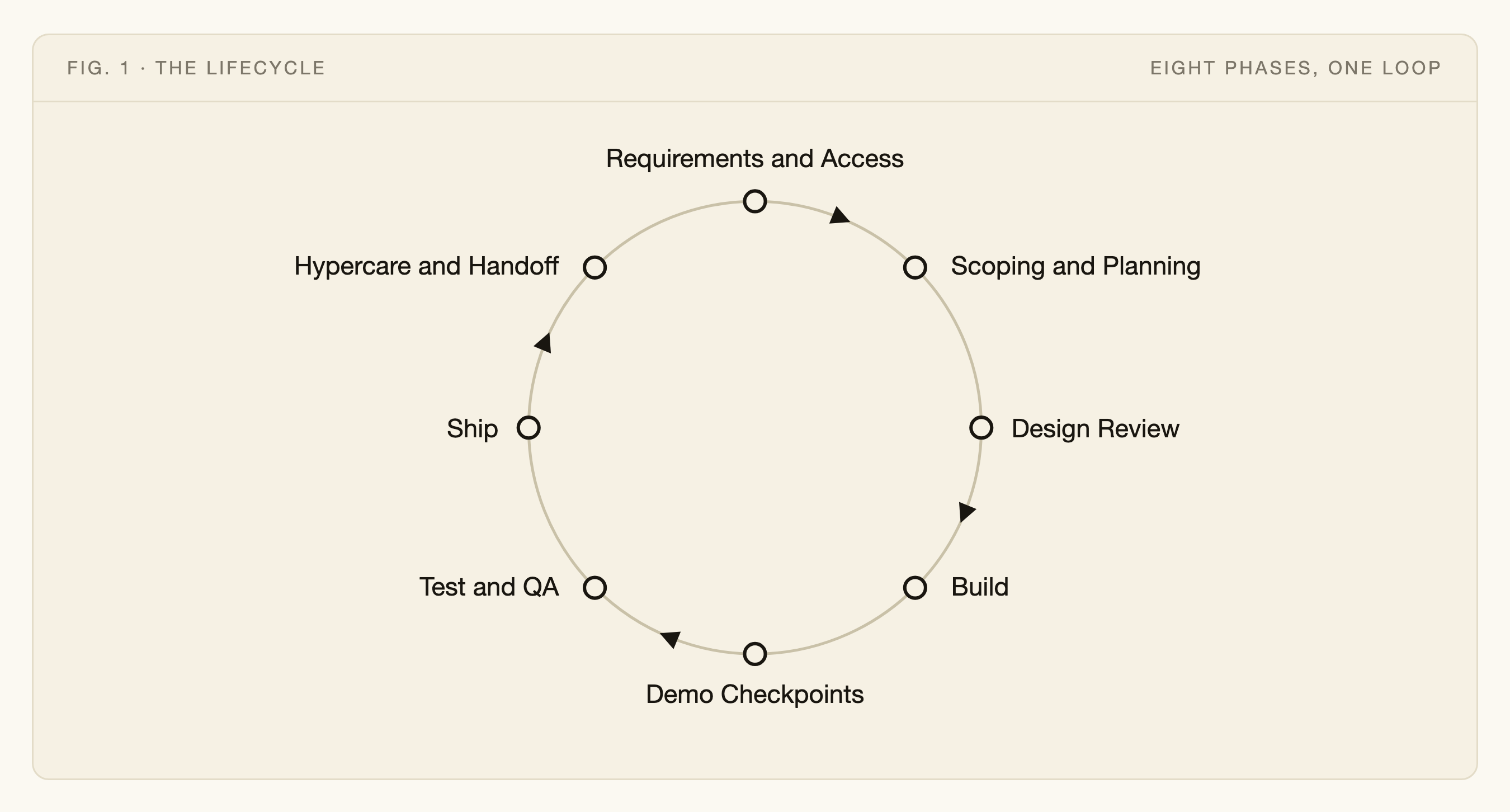
What changes when agents do the work is what happens inside the loop: how much gets written down, who reads it, and what gets checked before work moves on.
The essence of MetaHarness reduces to eight principles:
- Context as code.
- Plans are detailed, and allowed to change.
- Every agent starts senior.
- Skills ship like software.
- One record, many views.
- Let agents check their own work.
- Status is derived, not reported.
- Lessons compound for everyone.
Context becomes part of the system
Principle 1: Context as code.
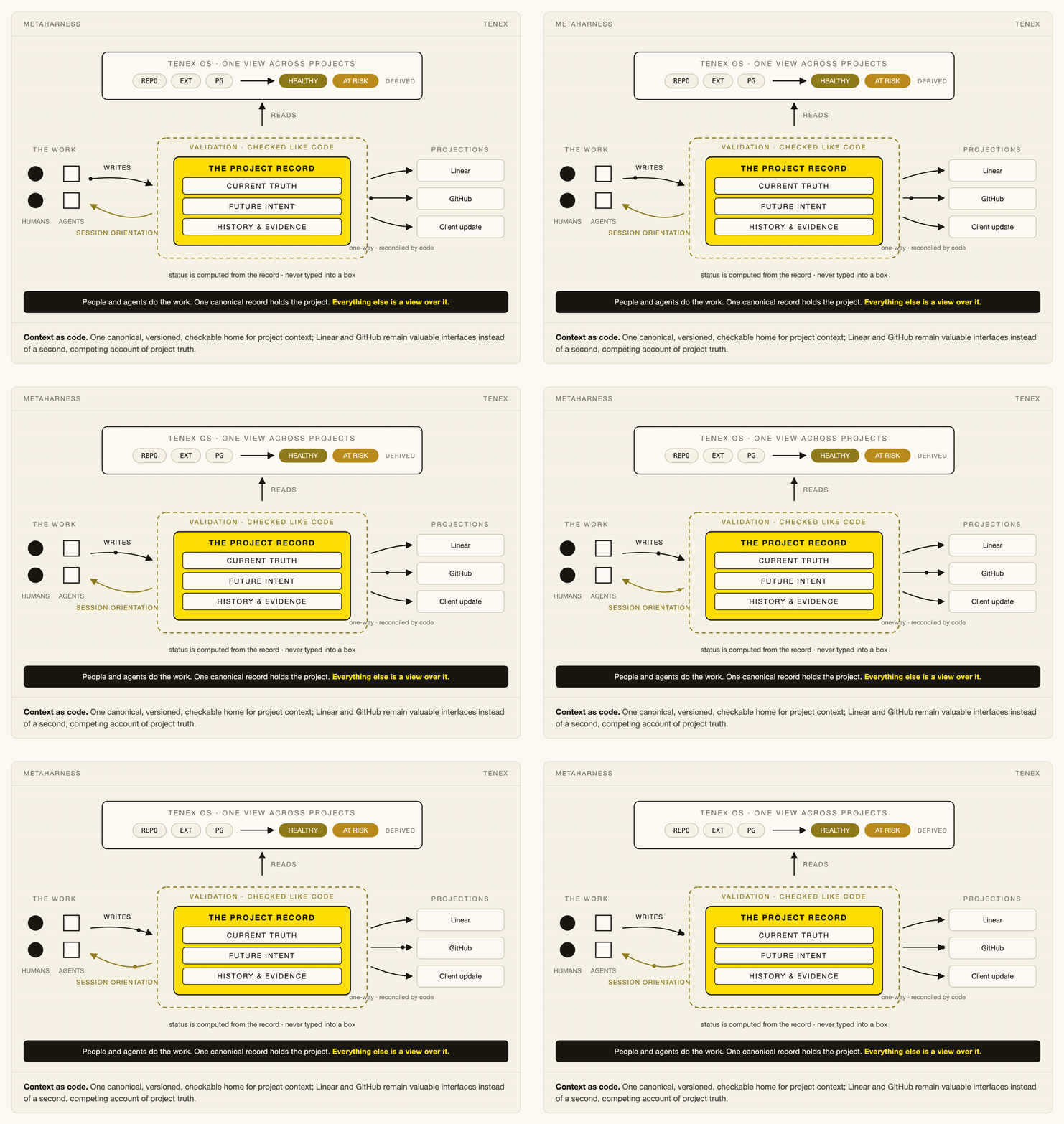
We treat context as code. If project context determines what agents build, it needs the properties we expect from source code: one home, versioned and reviewable changes, known shapes, checkable relationships, detectable staleness.
We call this home the project recordOne versioned home for everything a project knows about itself: a git repository of markdown, sitting next to the code it describes.: a source of truth holding everything a project knows about itself, sitting in the repo next to the code base. It works the way double-entry bookkeeping does. Both sides have to balance, and a discrepancy is an error you can point at rather than a game of he said she said. What is true, what is planned, and what happened are recorded separately, cross-referenced, and checked.
The names are ours and yours would differ, but the shape underneath matters. Every project gets a git repo of markdown with strict grammar. Current truth lives in 1-docs/, intent splits between 2-epics/ and 3-project-specs/, history goes in 4-log/, and anything archived moves under .archived/, where the tooling refuses to write. Filenames follow a pattern the parser knows, so ARCH-system-overview.md is a record and arch_system_overview.md is an error with a fix suggested.
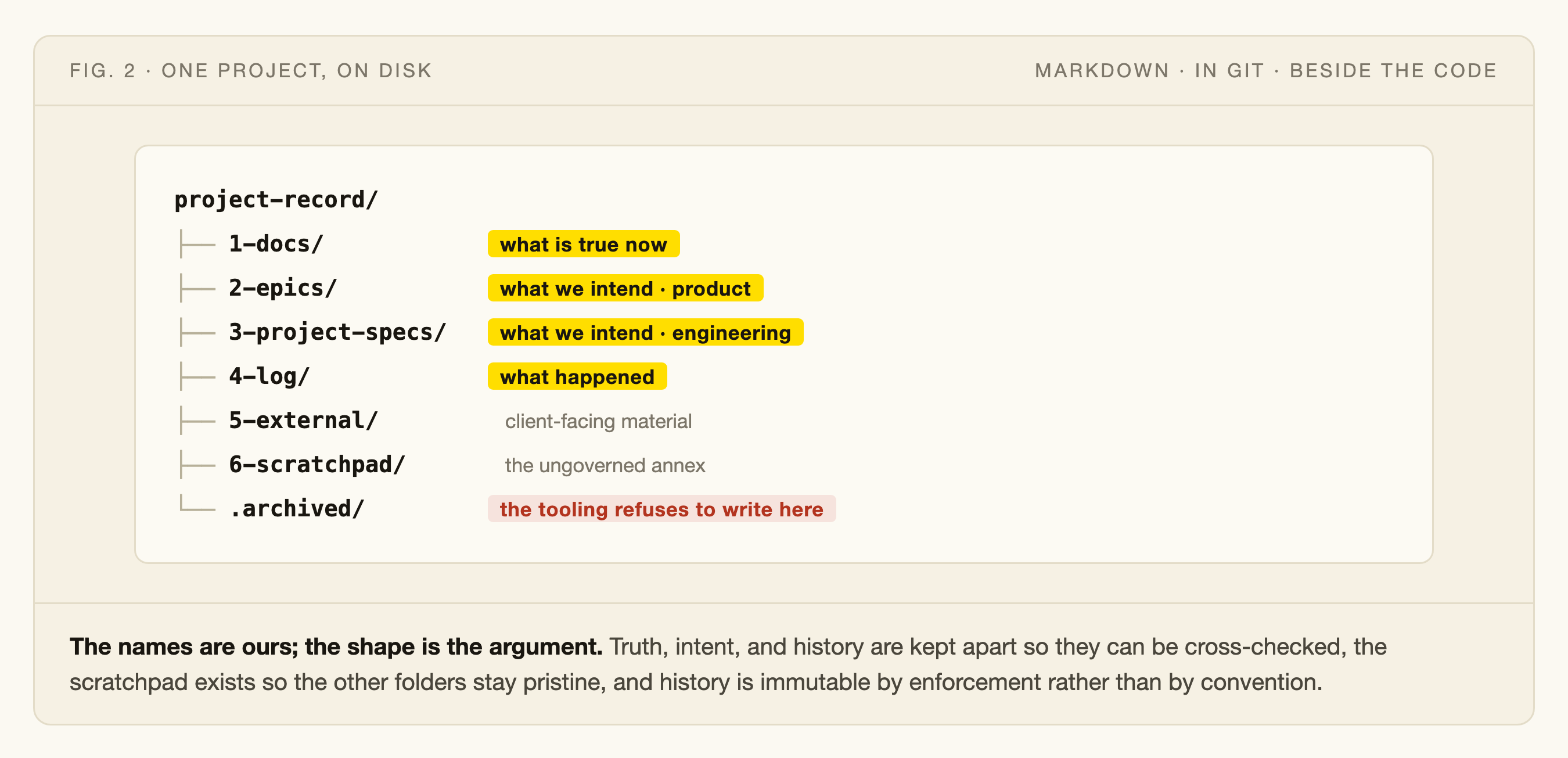
6-scratchpad/ exists so the others can stay pristine. If there is nowhere to put a messy thought, people put messy thoughts into the canonical documents. A governed system needs an ungoverned annex, or the governance leaks.
Inside each planning file, the boundary is about who may write, not what the system may read. People edit the prose freely. The CLI parses the whole document, but when it syncs from Linear or GitHub it only rewrites the fenced blocks reserved for machine output: external IDs, status, metadata. The reasoning around those blocks is never touched. It is a mutex expressed as syntax.
A blueprint that is allowed to change
Principle 2: Plans are detailed, and allowed to change.
Historically, engineers had to be selective about time spent on planning & documentation. Hours were finite & competition against time spent ripping code was real. Agents collapsed that cost. It is now affordable to build a much more complete blueprint of a large system before implementation starts, and to keep it current as the work changes.
That blueprint gives every person and agent the same account of what we are building, why it matters, and what must be true before the work is accepted. The artifacts are useful to humans and force agents to behave deterministically.
Moreover, deeply opinionated structure is must-have. Every ticket belongs to exactly one MetaHarness checkpointA demoable slice of a project spec. Every ticket belongs to exactly one, or is exempted on the record. or is explicitly exempted. A spec with tickets and no checkpoints is an error. And acceptance criterionA checkable statement of what done means for one ticket. It belongs to that ticket because it sits under it. aren’t committed to memory; a criterion belongs to a ticket, making pass/fail legible to agents.
This is more planning than many agile teams would consider economical, and it is not a return to a fixed specification. We still work in sprints, epicThe product artifact. What we are building, who it is for, and the outcome milestones that define success., milestoneA product outcome inside an epic. Not a date, and not a lifecycle phase., tickets, and demos, and we still expect plans to change once the team learns something. The difference is that these parts belong to one connected blueprint rather than a set of loosely related tracker entries, which also makes readiness measurable: how much work is scoped ahead, and where the plan runs out. That gives our engineering managers an early warning before a team reaches the end of its prepared work.
We practice benevolent prompt injection
Principle 3: Every agent starts senior.
Maintaining context hygiene is half the problem. The process also has to deliver it at the moment an agent begins working.
An agent opening ticket 3 on a payments spec does not start with a blank prompt. It starts with the architecture doc, the two decisions logged last week, the acceptance criteria that define done for that ticket, the fact that validation is currently clean, and the commands that let it verify its own claims. Managed startup hooks assemble that packet automatically, across the agent environments our engineers use.
We like to think of this as benevolent prompt injection. We inject the project’s rules, requirements, process, and current state before the task begins, so a new session does not depend on a user starting with the right prompt.
No session starts junior. A new agent follows yesterday’s conventions, an agent waking after a pause inspects current state instead of trusting an old snapshot, and a replacement takes over without a person retelling the story.
Tribal knowledge is embodied by shared skills
Principle 4: Skills ship like software.
The instructions agents receive are managed as a shared company system rather than a collection of personal prompts.
Tenex maintains more than fifty reusable skills. There is one for writing a project specThe engineering plan derived from one or more epics. It holds the checkpoints and the tickets., one for executing a ticket against its acceptance criteria, one for investigating a bug, one for preparing a pull request, one for reviewing whether a doc still matches the code. A skill loads when the task calls for it and stays out of unrelated sessions, so an agent gets detailed guidance without carrying the whole company handbook in every context window.
They are versioned, tested against fixtures, and released through standards channels, so a process change rolls out deliberately. An engineer can change tools without losing the firm’s way of planning, reviewing, and shipping work.
This is how a local lesson becomes company capability. When one project finds a better way to review an architecture or validate a release, that improvement goes into the relevant skill and every future session inherits it.
The development process has a machine interface
Principle 5: One record, many views.
Without a machine interface, an agent working in your repo has to read files and guess. The Tenex CLIThe machine interface to the record. Agents ask it what is true, what is ready, what is broken, and what happens next. removes the guesswork & enforces guardrails (through 30+ commands) so engineers don’t need to babysit the codebase.
An agent asks what is true, what is ready, what is broken, what happens next, and gets structured facts. Examples:
- Which tickets are unblocked.
- Where the record and Linear disagree.
- What required sections of plans are missing or invalid.
- Make Linear match the markdown.
- Approval of acceptance criteria.
Every answer is grounded in the project record, so an agent is never working off stale source of truth.
Writes to Linear and GitHub work the way infrastructure tools have for a decade: you see the full plan before anything executes, and applying it takes a separate deliberate step. If a ticket could plausibly match two Linear issues, it refuses and names both.
The value of the Tenex CLI is that a write to Linear is either correct or it doesn’t happen. If the project record is the blueprint, the CLI is what turns it into work orders and sounds the alarm when Linear stops matching the blueprint.
Validation makes autonomy safer
Principle 6: Let agents check their own work.
Agents must be kept on a leash, because they can be convincing and wrong. So trust is earned through verification. Plans are checked for missing relationships, tickets against their acceptance criteria, documentation against the code.
The checks also give an agent a way to repair its own work. tenex validate returns something like PS-portal ticket 6 points at milestone M3, which does not exist; relink or remove. Guidance that’s precise enough for the agent to self-heal and run the check again, with no human intervention needed. Long tasks stop depending on an agent holding a perfect chain of reasoning for hours.
What gets to the engineer is an error the agent couldn’t self-correct. An agent marking a ticket done when nothing links to a PR, tests, or a sign-off does not get to make that claim stick.
Run 1 · drift, caught and self-repaired
Run 2 · a claim without evidence
polished and wrong at the same timeAn agent becomes more useful when it has the context to understand the objective, the tools to act, a bounded authority, observable criteria for progress, durable state, and a clear escalation path. Removing those constraints would not make it freer, only less certain, and would put a human back in the loop to repair the ambiguity. The goal was never maximum autonomy. It is to remove unnecessary dependence on human attention while making the moments that genuinely need a person easier to spot.
Tenex OS makes the process legible to the team
Principle 7: Status is derived, not reported.
The same structured state powers Tenex OSThe human-facing surface. It reads the same record and derives delivery health for engineers, managers, and leadership., our human-facing surface. An engineer examines the work closest to the build, an engineering manager is kept abreast of planning and quality risk, and leadership can scan delivery health across all projects.
A status report built off of memory is subjective at best, lossy at worst. When epics, specs, tickets, branches, and PRs are connected the system provides a verifiable source of truth & flags disagreements. If the system says a ticket is complete but evidence is missing, the inconsistency becomes visible. There are no surprises.
What an engineer needs: what is unblocked, what is missing evidence, and what the validator is rejecting right now.
What a manager needs: where the plan is thinning, which quality gates are unmet, and how much runway is left before a team runs out of scoped work.
What leadership needs: delivery health across every project, with missing data shown as missing rather than guessed green.
The process learns from the work
Principle 8: Lessons compound for everyone.
Each project can improve the system used to run the next one. A repeated planning gap becomes a new check. A useful way of investigating a codebase becomes a skill. A decision that keeps causing confusion becomes an explicit convention. A manual status reconciliation becomes a CLI command.
Traditional organizations learn too, but that learning spreads through people, onboarding, and team culture. The added opportunity is to encode a lesson so it changes the default behavior of every relevant session, so improvements travel as tested, versioned changes instead of advice that depends on everyone hearing and remembering it.
This is why the process itself becomes a durable asset. The client still gets the software, and the team gets better at producing software, because the system around the work retains what it learned.
What the process expects of people
An SDLC this automated can imply judgment has also been automated. This couldn’t be further from the truth. If anything, the standard we hold each other to continues to climb.
Agents are like funhouse mirrors. Used well, they make a strong engineer dramatically more capable. Used carelessly, they let weak fundamentals produce spaghetti code and slop. The system multiplies judgment, it does not supply it.
Let’s be clear: the job of an engineer has changed shape. Engineering is higher level and multithreaded now: articulating intent and architecture clearly enough that many agents can act on it, taking on harder problems because the cost of attempting them fell, steering a fleet of agents efficiently across time and tokens, and keeping the codebase from decaying while all of that happens at once.
So the output is yours. There is no such thing as “Claude told me to do it.” If you merge it, send it, or show it to a stakeholder, you are accountable for it being right, and reading what you shipped is not optional. You make your bed. You’re responsible for sleeping in it.
Where to start
You can start this today, for free, in any codebase. It takes one project and a few weeks of discipline. If we were starting over, this is the order we would do it in.
Start with three folders, not seven. What is true now, what we intend to build, and what happened. Put them in the repository next to the code, in markdown, and resist designing a taxonomy before you have used one. Add the scratchpad fourth, sooner than you expect, because the alternative is people putting rough notes into the canonical documents.
Write one blueprint, for one real project. What you are building, why it matters, the major boundaries and decisions, the next few slices of work, and what must be true before each is accepted. This is the artifact that does the most work, and writing it with an agent takes hours rather than days.
Adopt the fence rule on day one. Decide which parts of a document a machine may rewrite and mark them off, whether that is a code fence, a comment marker, or a separate file. Retrofitting this means untangling every document where a sync has already overwritten someone’s prose.
Add one validator, however small. A script that flags tickets pointing at milestones that do not exist, or documents untouched since the architecture changed. One check is enough to change the failure mode: drift starts producing a failing check instead of a quiet surprise six weeks later.
Give every session the same starting packet. Assemble it from those files, so orientation stops depending on whoever wrote the prompt that morning, and derive one view of project health from the record instead of asking a person to write one.
Then watch where it strains. Wherever the record is missing, stale, or wrong is where your process currently runs on memory, and each one you fix compounds.
Two honest limits. Below a certain size this is overkill: one team on one project drifts slowly enough that the ceremony costs more than it saves, and the approach pays for itself as concurrency grows. And it depends on one commitment technology cannot supply, which is writing things down. Validation exists because discipline alone eventually fails, but a team that refuses to write anything down has a different problem to fix first.
What is actually different
The old tradeoff placed detailed planning on one side and speed on the other, because humans maintained every part of the process by hand. Agents change that tradeoff. Structure increases speed when it removes repeated discovery, prevents incompatible work, gives every agent a reliable starting point, and makes failures easier to detect and repair.
The practical test is whether a new agent can enter a project, understand the intended system, choose work that fits the current plan, load the company’s method for doing that work, prove what it changed, and leave the project easier for the next agent to understand. The test for the organization is whether engineers and managers can inspect that work across many projects without reconstructing reality from meetings and manually updated dashboards.
If both are true, coding agents become more than faster implementers. They become participants in a development system that can take on more complexity without losing the thread.