
You can't judge an AI pilot, a data layer, and an invoicing agent by the same standard. The 1-3-1 framework: one foundation, three budgets, and one rule for counting returns.
TL;DR
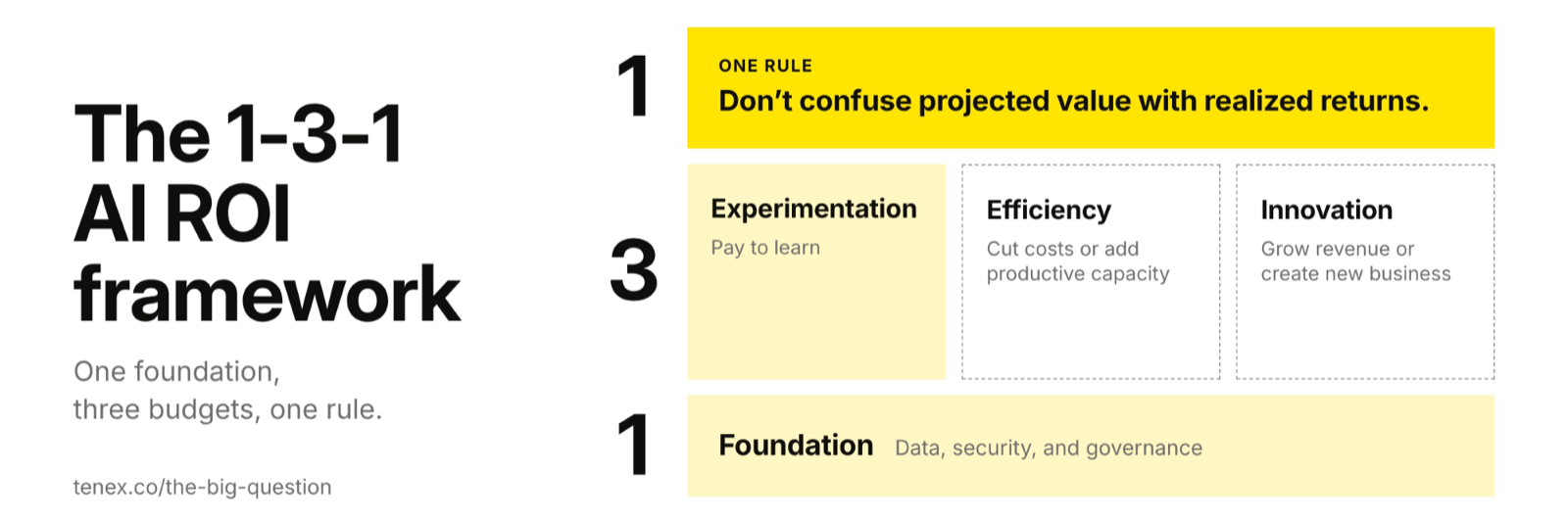
You can’t judge an AI pilot, a semantic data layer, and an invoicing agent by the same standard. Our 1-3-1 framework allocates budget for infrastructure and experimentation, then makes cost-cutting and revenue-generating projects earn more funding as they prove their value. Each is judged by the metrics its team already uses. And projected returns don’t count as money earned or saved until the business actually captures them.
Why AI ROI is so hard to pin down
Imagine you’re the CEO of a midsize company, and four teams come to you about AI:
- Finance says its invoicing agent is saving hundreds of hours.
- Marketing says its AI video creative has lifted conversion rates.
- Engineering says its coding assistant has developers pushing PRs twice as fast.
- IT wants a substantial budget for data engineering, with no direct financial return to promise.
These are four different kinds of investment, measured at different units of work. Companies tend to ask the same question of each initiative: what’s the ROI? But the answer requires different measures, and time saved doesn’t necessarily translate into recognized revenue or profit.
Start with what you’re funding, then define the business case and the KPIs that will measure success. That’s the logic behind 1-3-1: one protected foundation, three budgets (experimentation, efficiency, and innovation), and one rule for counting returns.
One foundation, three budgets, one rule
How much should you spend on AI?
Set a company-wide AI spending ceiling rather than letting each department establish its own budget. Individual projects then earn a share of that money with a business case. For companies early in an AI transformation, our suggested starting range is roughly 0.5% to 2% of annual revenue.
That’s deliberately below what established programs spend. In a September 2026 BCG survey of 1,330 executives, companies reported putting about 3.3% of revenue into AI, up from 1.7% a year earlier.
Two kinds of spending (foundation and experimentation) get committed money inside the ceiling, and everything else has to earn its share with evidence.
The four categories
Every AI initiative falls into one of four categories, each with its own share of the budget and its own definition of success.
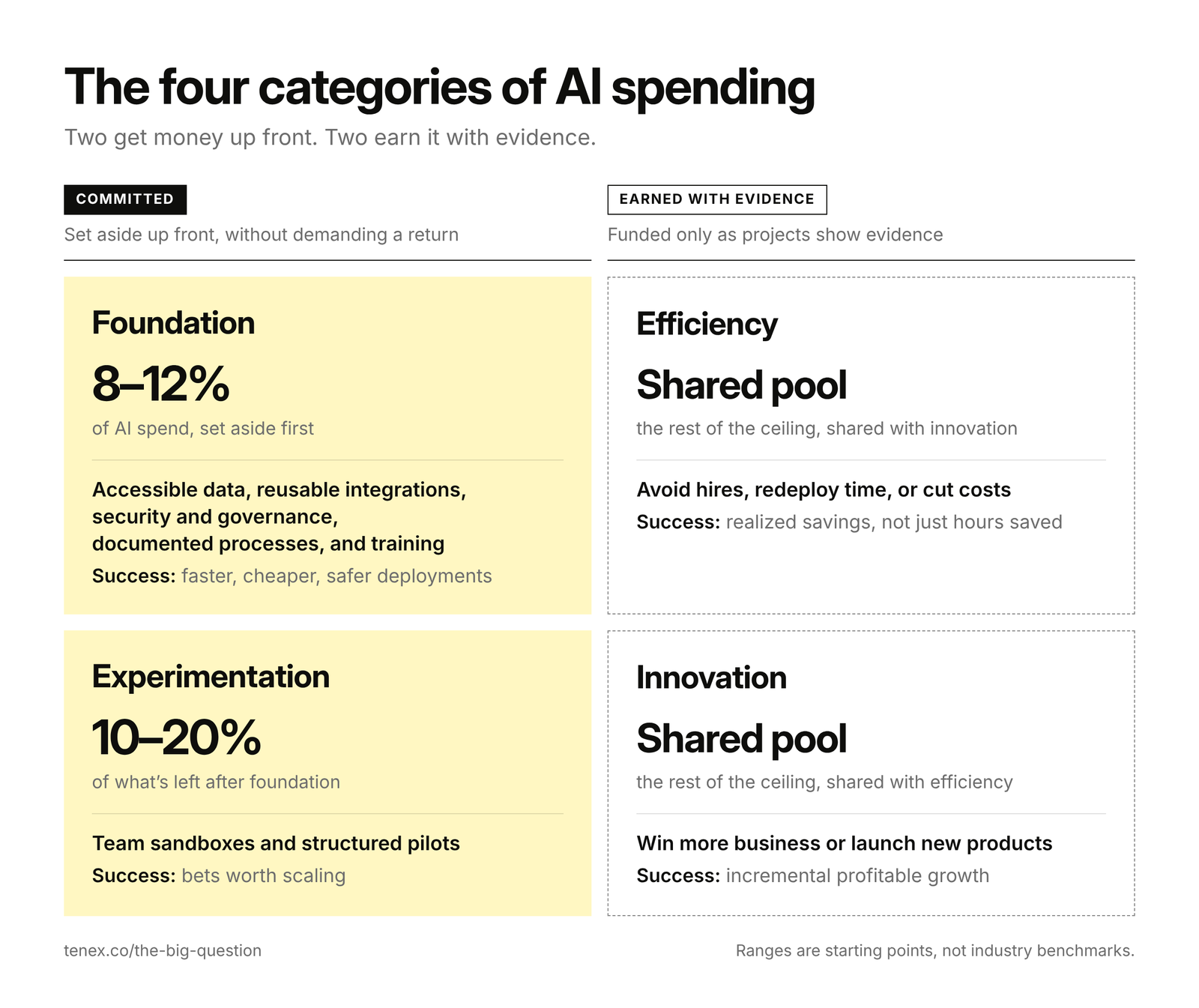
Foundation is the shared infrastructure every AI project runs on. It’s the operating cost of deploying AI securely and reliably, so it gets money committed up front. If the foundation budget is too small, each project has to pay for its own governance, which makes every project look worse than it is and tempts teams to skirt guardrails. Every enterprise needs it, though the 8–12% range is set for regulated industries like insurance.
Experimentation funds teams trying AI on real work, from a sales team drafting proposals under a monthly API cap to a structured pilot on hundreds of support tickets. Treat it like R&D: set aside an amount you can afford to lose entirely, and size it by how many experiments you want to run. A good experiment either turns up an idea worth scaling or rules one out quickly and cheaply. A bad one keeps running without doing either.
Efficiency and innovation are the budgets that have to be earned. Efficiency funds AI that cuts costs; innovation funds AI that grows revenue. Neither gets money until a project clears the evidence bar for its function. The sections below show what that evidence looks like for each category.
In practice: Meridian’s budget
Meridian Specialty Insurance is a fictional insurer with $500 million in revenue, and its figures are illustrative. It’s early in its AI transformation, so it starts below its peers and raises the ceiling as projects prove out:
- $5 million spending ceiling (1% of revenue): well below the 3.3% average in BCG’s survey.
- $400,000 committed to foundation: 8% of the ceiling, the low end of the range, for a governed data layer, security and governance guardrails, and role-based training.
- $700,000 committed to experimentation: about 15% of what’s left, enough for more than two dozen pilots the size of its $25,000 claims test.
- Up to $3.9 million for efficiency and innovation: available only to projects that justify the investment.
Fund each initiative from the budget that matches its purpose: foundation, experimentation, efficiency, or innovation. It may deliver other benefits, but count each return only once.
One rule: Track realized returns against projections.
A project expected to save $1 million hasn’t saved it yet. Keep the projection as the benchmark, then track what the business actually captures, including the costs of getting there.
When shouldn’t you care about ROI?
Foundation and experimentation pay off over a longer horizon, so don’t judge their business cases on IRR or NPV alone. Experiments should tell you which ideas deserve more money. Foundation should make each deployment easier than the last. Here’s how that plays out at Meridian.
Experimentation: Judge it by the bets it finds
Meridian gives its claims team a small experimentation budget, with a $5,000 monthly cap on API spending. One adjuster finds that AI can summarize an 80-page claim file in 20 minutes instead of 90. One file tells Meridian little about how the tool will perform across hundreds of claims, especially the difficult ones. But it’s enough to write down a hypothesis worth testing: if AI can summarize claim files reliably, it could cut average processing time by 40%.
Meridian runs a $25,000 pilot on 500 claims, less than a tenth of what a full rollout would cost. Before it starts, the team writes down what results would earn the idea a full business case: at least 90% of summaries pass its quality checks, and processing time still drops by about 40% after adjusters review each summary. On straightforward files, 92% of summaries pass and the time savings hold. On complex files, only 78% pass.
The results narrow the bet. Routine files, about 70% of the volume, advance to a full business case, with human verification required: about $1.1 million a year in adjuster capacity against $300,000 to roll out and $180,000 a year to run. Complex files stay with adjusters for now. That version goes back to experimentation, where the team can test better retrieval or a newer model before it gets more money.
Without that decision, Meridian could keep calling the complex-file results promising and fund another quarter of testing, then another. That’s pilot purgatory. Every pilot should end in a call to scale, revise, or stop. Revising means changing something specific and testing again, not rerunning the same pilot.
Our AI strategy Big Question covers how to write those go/no-go criteria.
Foundation: Judge it by what it makes possible
Many AI projects stall between demo and production on data access, security review, or integration, not on the model itself. Foundation does that work up front, so each new project repeats less of it. It comes before any single use case because it decides how fast and how safely every later project can ship.
Say you build a semantic data layer, one certified definition of every claim, policy, and loss metric, and five agents pull from it through the same governed tools. When those agents start saving money, how much of that return belongs to the semantic layer? It’s hard to say; that’s why measuring the ROI of foundational work like data engineering, security, and integrations is tricky.
But you can measure what it makes possible: how many new use cases launch because it exists, how fast they reach production, what each one costs compared with the first, and how quickly it clears security review. Also check whether people actually use it: whether teams work from the shared data and tools, whether employees use what they were trained on, and whether later projects reuse what earlier ones built. A data layer nobody queries hasn’t made anything possible yet.
At Meridian, the first agent takes nine months to deploy. The next takes six weeks. By then, the claim and policy definitions are certified, the connections to the claims and policy systems exist, and security has approved the access controls. The second agent also costs about a third as much to build and clears security review in two weeks instead of three months.
If an agent saves $1 million, you can’t also claim that $1 million as a return on the infrastructure that made the agent possible.
Don’t let foundation become a reason not to ship. Build it alongside your first two or three use cases, and let them show which pieces come first: put the committed money where a missing piece is holding back a use case whose value you already know. That tells you what to build next, not how much of the use case’s return the foundation can claim.
We recommend reinvesting about 20% of realized gains into foundation work early on. That protects it from short-term budget pressure and ties its growth to real results. As the foundation matures and needs fewer new pieces, the share can come down.
When does potential ROI become real?
When the business captures it. That’s the test for efficiency and innovation. A pilot can prove people work faster without the company saving or earning a dollar more, and that gap is the difference between provisional and realized value.
Provisional versus realized
Provisional value is an observed or projected improvement whose financial benefit the business hasn’t yet captured. Realized value is what the business has actually gained through lower costs or incremental revenue, accounting for the costs of achieving it.
Efficiency: Judge it by realized savings
The pilot’s business case put the claims tool’s freed capacity at about $1.1 million a year. But if adjusters work the same hours, staffing costs don’t change, and nothing new gets done, that benefit is still unproven. As our co-founder Arman puts it, “gross productivity gain is not realized savings.”
There are three ways to turn recovered capacity into value:
- Hiring avoidance: take on more work without filling planned roles.
- Productive redeployment: move people to work that improves a measurable outcome.
- Cost reduction: cut expenses or positions you no longer need.
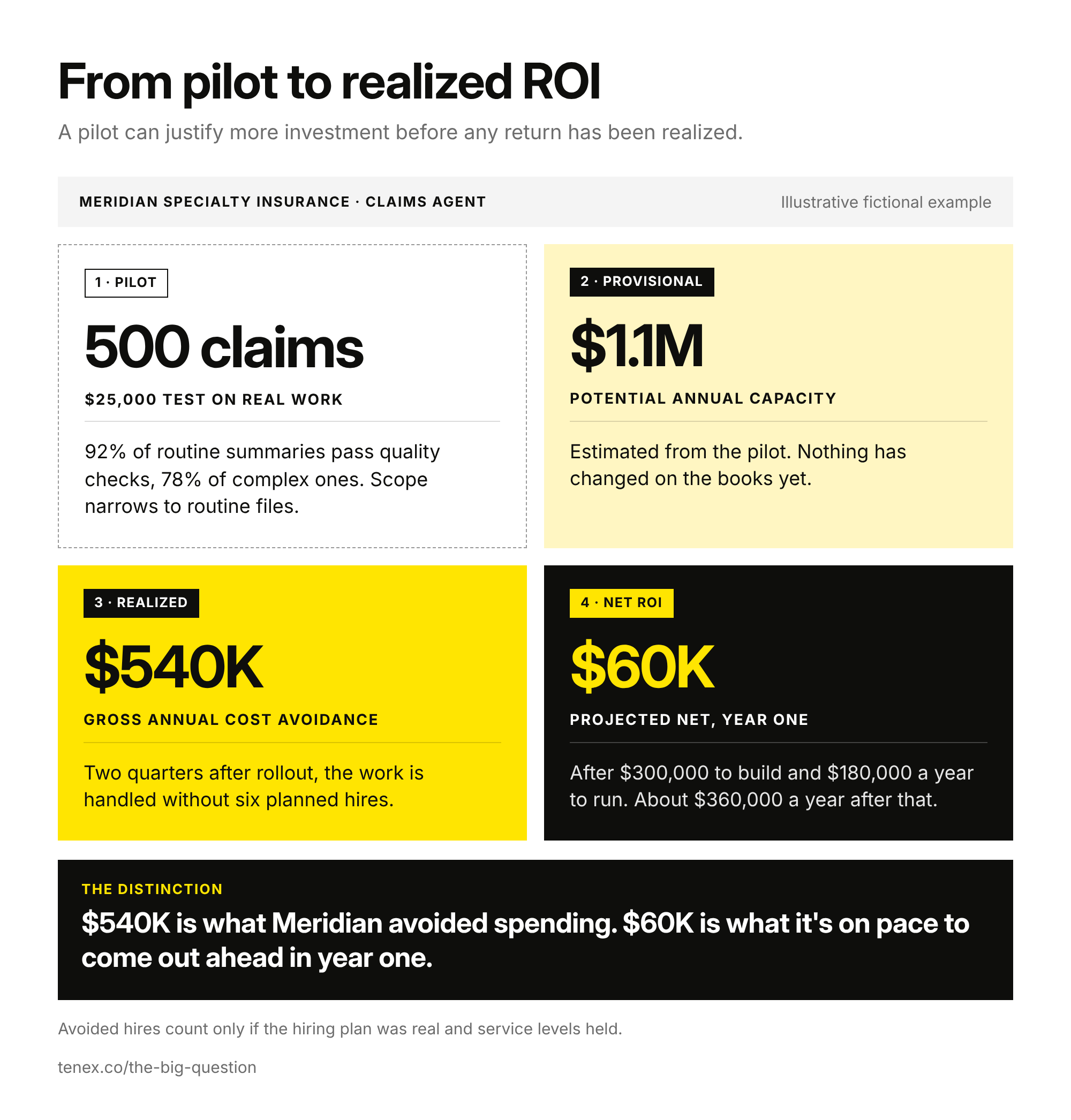
Before rollout, Meridian commits to absorbing the work of six adjusters it had planned to hire, about $540,000 a year in employment costs, and to moving the rest of the freed capacity to complex claims. Two quarters after deployment, it’s handling the projected workload without those hires. As long as the hiring plan was real and service levels held, that’s $540,000 in annualized gross cost avoidance.
Meridian moves the rest of the freed time to complex claims. Any additional return has to be demonstrated through improved outcomes, such as faster resolution or fewer overpayments. The hours that replaced the six hires are already accounted for in the $540,000 and can’t be counted again.
Gross savings isn’t the same as ROI. Meridian still has to subtract the full cost of the agent: software, integration, training, ongoing operation, human review, and error correction. Say the agent costs $300,000 to build and roll out, and $180,000 a year to run. Against $540,000 in avoided hiring, Meridian nets $60,000 in the first year and $360,000 a year after that. (The $25,000 pilot came out of the experimentation budget, so it isn’t counted here, though the program still spent it.)
Before approving a major efficiency rollout, leadership should name where the freed capacity will go and who’s responsible for capturing its value. Review provisional gains after one to two quarters and withdraw the ones that haven’t materialized, so they don’t pile up as if they were real.
Innovation: Judge it by revenue you can attribute
Meridian’s underwriting team uses AI to cut quote turnaround from three days to four hours. It projects that the bind rate, the share of quotes that become policies, could rise from 22% to 26%. At 50,000 quotes a year and an average annual premium of $4,000, that would be worth about $8 million a year in additional premiums.
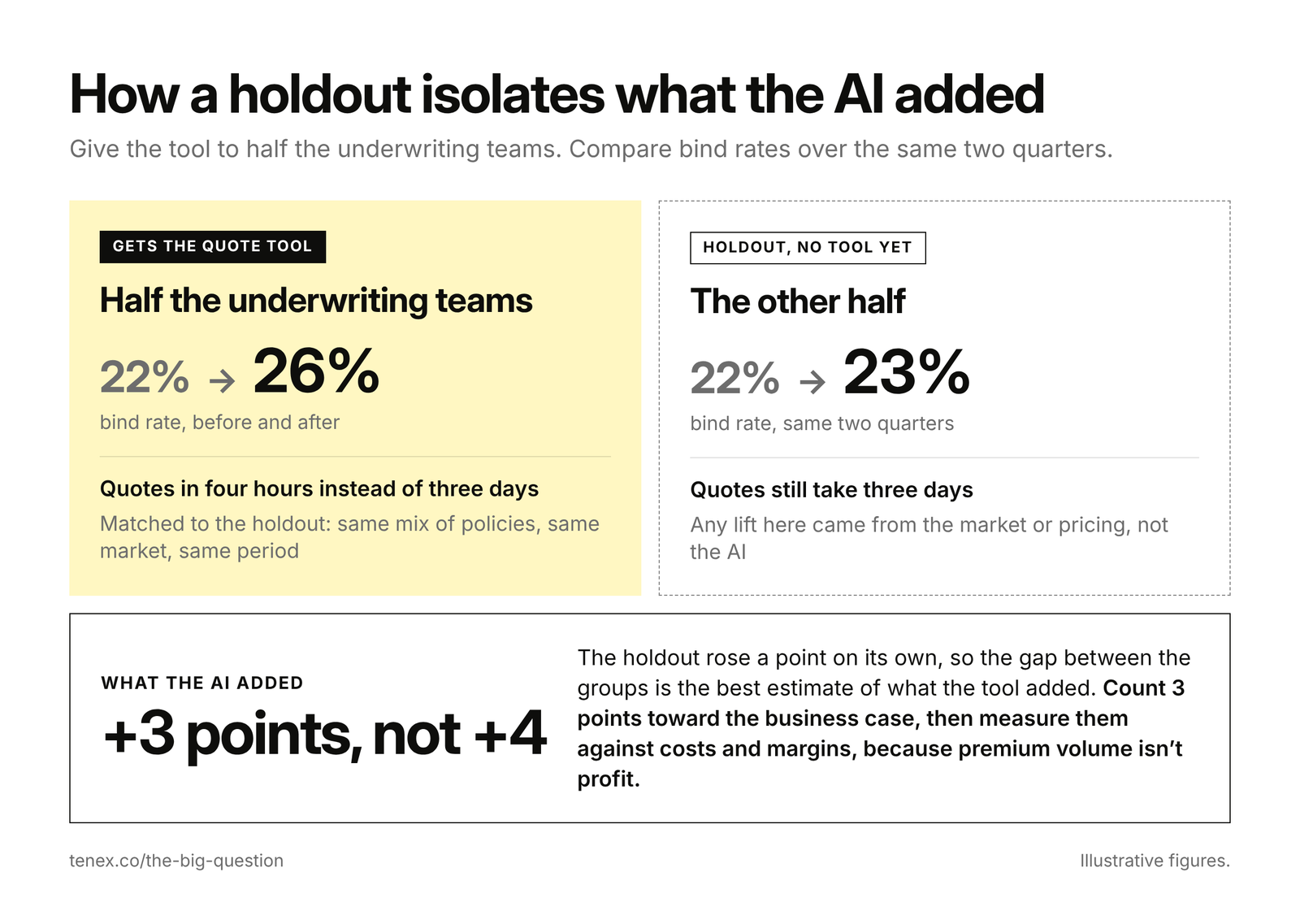
Faster quotes don’t necessarily lead to a more profitable business. A higher bind rate could come from market conditions, pricing changes, or something else. Where you can, use a holdout group or a staggered rollout to isolate what the AI added. Then measure the gain against its costs and margins, because premium volume isn’t profit.
Meridian’s plan is to give the quote tool to half its underwriting teams, matched to the other half on the policies they write, and compare the two groups’ bind rates over the same two quarters.
Revenue also takes longer to show up. Some innovation investments need two to four quarters before you can judge whether they’ve paid off. Leading indicators, like quote turnaround and the holdout group’s early bind rate, can tell you within a quarter whether to keep going, change course, or stop.
How do you compare AI investments with different KPIs?
Each initiative proves itself in the measures its function already owns, and the ones that qualify get funded in order of how strong their evidence is.
Judge each one by its existing metrics
Tenex’s principle is that AI doesn’t create new laws of business performance. Companies already know how to measure their departments’ work, and those measures should stay the starting point.
| Application | What to measure | Not enough on its own |
|---|---|---|
| Invoicing agent | Cost per invoice, processing time, error rate, verified savings | Employees’ estimates of time saved |
| Marketing agent | Conversion, qualified pipeline, acquisition cost | Content output or lead volume |
| Engineering tool | Time from ticket to deployment, tickets shipped compared with before, how often tests and checks pass, defect rate | Developer happiness, lines of code, merged pull requests, or spending on AI usage |
Meridian’s claims agent clears its bar with verified cost avoidance. Marketing clears its bar with growth in qualified pipeline. Engineering can only show that developers like their tools, so it stays in experimentation.
How should funding be allocated?
Scale the bar to the investment: a $20,000 tool doesn’t need the same proof as a $2 million rollout. A successful pilot can justify more funding before it delivers a realized return. How much more depends on your risk appetite, the size of the opportunity, and the cost of waiting.
An initiative first has to clear the evidence bar for its function. Among the ones that do, weigh how much each could be worth against how strong its evidence is, and fund the best bets first until the budget runs out.
Meridian has up to $3.9 million for efficiency and innovation. Expanding the claims agent is first in line: the initial deployment has avoided six planned hires, and its operating costs are known. Marketing’s qualified pipeline has grown alongside its AI content for two quarters, so it’s funded next. The quote tool gets nothing more until the holdout shows whether it lifted the bind rate. The rest of the budget stays uncommitted.
The AI Triage Matrix helps you find valuable opportunities you can execute. The 1-3-1 framework decides what evidence earns them more money as they mature.
Is your AI program working?
Judge each investment against the targets set when it was funded. No single metric tells you whether an AI program is successful. What matters is whether returns are meeting projections, experiments are producing funding decisions, and shared infrastructure is making comparable deployments faster, cheaper, more secure, and more reliable.
A company can have several successful AI pilots and still run an unsuccessful AI program.
Here’s Meridian’s review two quarters after the claims agent went live:
| Initiative | Cost | Target set at funding | Where it stands | Next decision |
|---|---|---|---|---|
| Claims summary pilot (experimentation) | $25,000 | Find which claim types can be summarized accurately enough to invest further | 92% of routine-file summaries passed quality checks; 78% of complex-file ones | Retest complex files with a specific fix; build a business case for routine files |
| Claims summaries, routine files (efficiency) | $300,000 to build, $180,000 a year to run | Absorb six planned hires, about $540,000 a year | Six hires avoided, worth $540,000 a year in gross cost avoidance; about $120,000 behind after six months, on pace to net $60,000 in year one | Expand to the next claims team once year-one costs are recovered |
| Faster quotes (innovation) | $500,000 to build, $250,000 a year to run | Bind rate from 22% to 26%, about $8 million a year in premiums | Turnaround down from three days to four hours; bind-rate lift not yet established | Test the lift against a holdout before adding funding |
| Shared data layer (foundation) | Part of the $400,000 foundation commitment | Faster, cheaper, more secure, and more reliable deployments | Second agent took six weeks instead of nine months, cost about a third as much, and cleared security review in two weeks | Measure what was reused, plus deployment cost, reliability, and security |
Three questions help interpret the review:
- Is value showing up? Partly. Meridian has avoided planned hiring costs, but its net return depends on the agent’s full costs. The quote project’s revenue remains a projection.
- Are experiments ending in decisions? The complex-file version went back for a specific fix instead of lingering. A company with 40 perpetually promising pilots may be making less progress than one that has deployed three useful applications and stopped the rest.
- Is the foundation paying off? The second deployment took six weeks, the first nine months. Because the projects weren’t identical, Meridian also checks what was reused and whether costs, security, and reliability improved before crediting the layer.
How to apply 1-3-1 tomorrow
Build the same table for what you’re already funding, with each initiative’s full committed and ongoing cost. Set each target when you approve the money, not after the results come in, and review the table every quarter. Use the starting ranges above for the budget split and the review windows, and adjust them to your financial position and goals. The output should be concrete: what gets more money, what needs another test, and what stops.
Judgment still matters
Two executives looking at the same promising pilot can reasonably make different calls about whether to expand it. But they should agree on what’s been demonstrated, what’s still a projection, and what the business has actually gained.
If you want help sorting your current AI spending into the four categories, get started with Tenex.