Stay Slop-Free: Say Yes to These 10 Questions
Ten yes-or-no questions, five on process and five on the artifact, to ask before your writing reaches its audience.
Slop writing is low-effort, low-quality work presented as authentic and meaningful, and as AI continues to improve, the problem worsens. We are not talking about all writing assisted by AI, nor about writing in places where AI assisted or generated writing is expected. We are talking about obvious LLM content where human content should be.
Addressing this problem requires an examination of both the writing process and the artifact that is a result of it. Process is your relationship with the work. The artifact is what others see. The aim here is simply making the best quality work that you can make, which can often be made better with AI assistance.
Ten questions before you hit send
Below we’ve put together ten questions, five for process and five for artifact, to ask yourself before your work reaches its audience. For process, this is entirely self-examination: an opportunity to be honest with yourself about how you worked on a particular piece of writing. The aim is to answer every question with an emphatic yes.
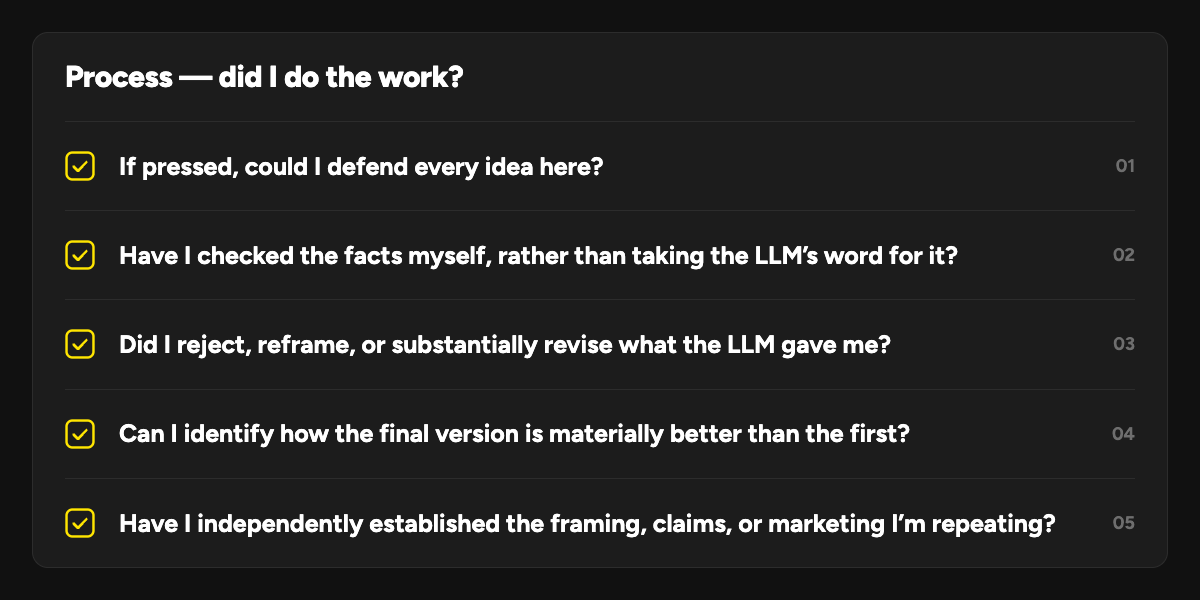
For the artifact questions, you’re really thinking about how your work is perceived. Again, it is important to be honest with yourself, but it is wise to consider a reader who is smarter than you.
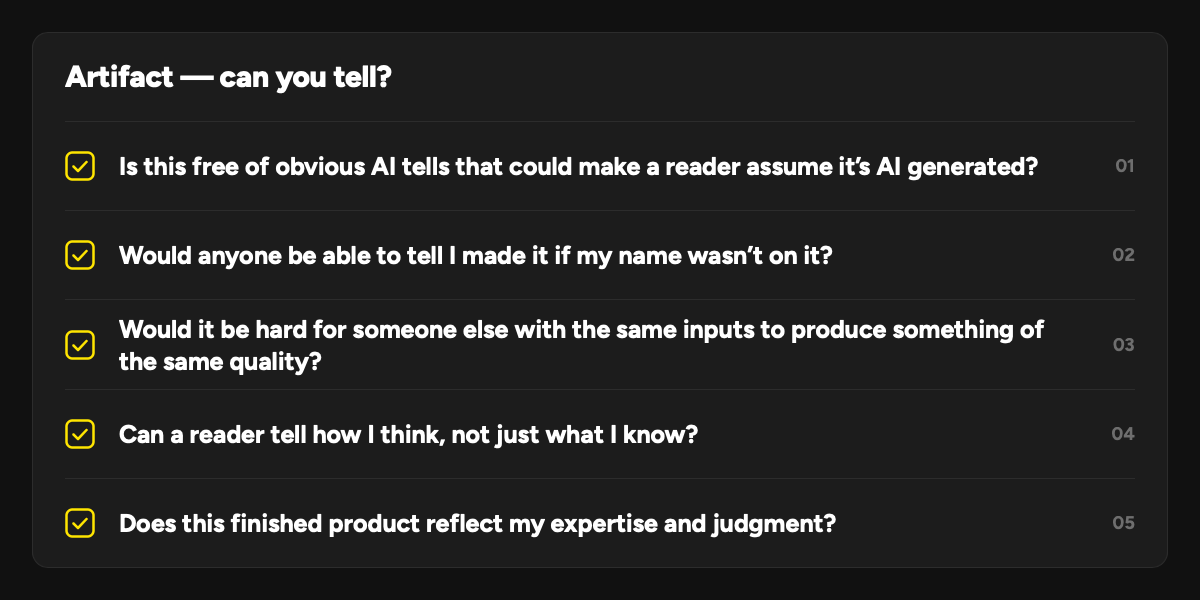
Just as with the process questions, you want to be able to confidently answer yes to each of these questions. It won’t necessarily mean the work is amazing, but it will mean that the work is yours. And just OK work that’s clearly yours is a heck of a lot better than slop writing that clearly isn’t.
The purpose of these lists is to keep us honest first with ourselves, then with everyone else. Putting slop out into the world with your name on it (even in low-stakes surfaces like social media) has a cost. What might be saved in time you risk paying for with the attention or trust lost. The work is less about proving your humanity than putting in work that is undeniable.

2026 Tenex. All rights reserved.

