
You don't have to rebuild everything first. Start with one business question, work back to the data it needs, and make each fix reusable.
Giving AI access to company data is only useful if the AI knows how to interpret it. The problem is that the rules for reading that data are rarely standardized. They often live in spreadsheets, scattered documentation, or people’s heads. Without that context, an agent can draw the wrong conclusions even from accurate data.
Thankfully, fixing this doesn’t take a massive set of rules written all at once. Start small with one business question, identify the data needed to answer it, and write down the rules for using that data. The work on each question leaves behind something the next one can build on.
What kind of data problem do you have?
When leaders say their data isn’t ready for AI, they can mean five different things, and each calls for a different fix. Some of what an agent needs isn’t in any system at all, like the know-how that lives in people’s heads, often called tribal knowledge. Here are the categories of data problems:
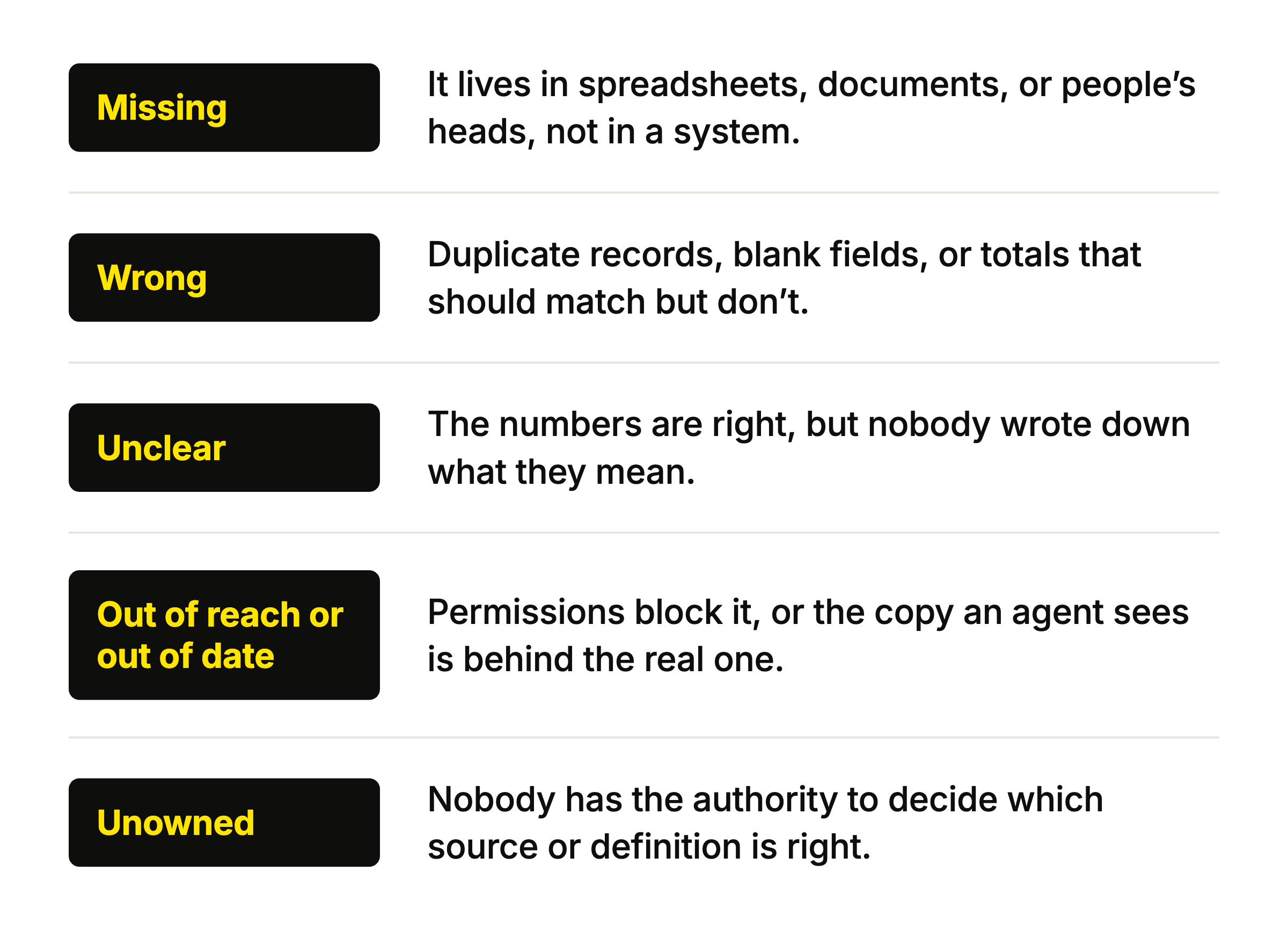
Most AI applications run into only a few of these problems. The work you want AI to do determines which ones to fix.
Start with the business question, then work backward
The tempting response is a company-wide modernization program: connect every system, clean every record, establish governance, and only then start building. Some companies do need much of that work, but doing it all first can delay learning what an application actually requires.
Start with the business question. Suppose finance wants to understand why profit margins fell last quarter. Asking an agent to investigate is one way to answer it, and that becomes the job. Work backward to the required data and definitions, identify what could make the answer wrong, and fix those dependencies.
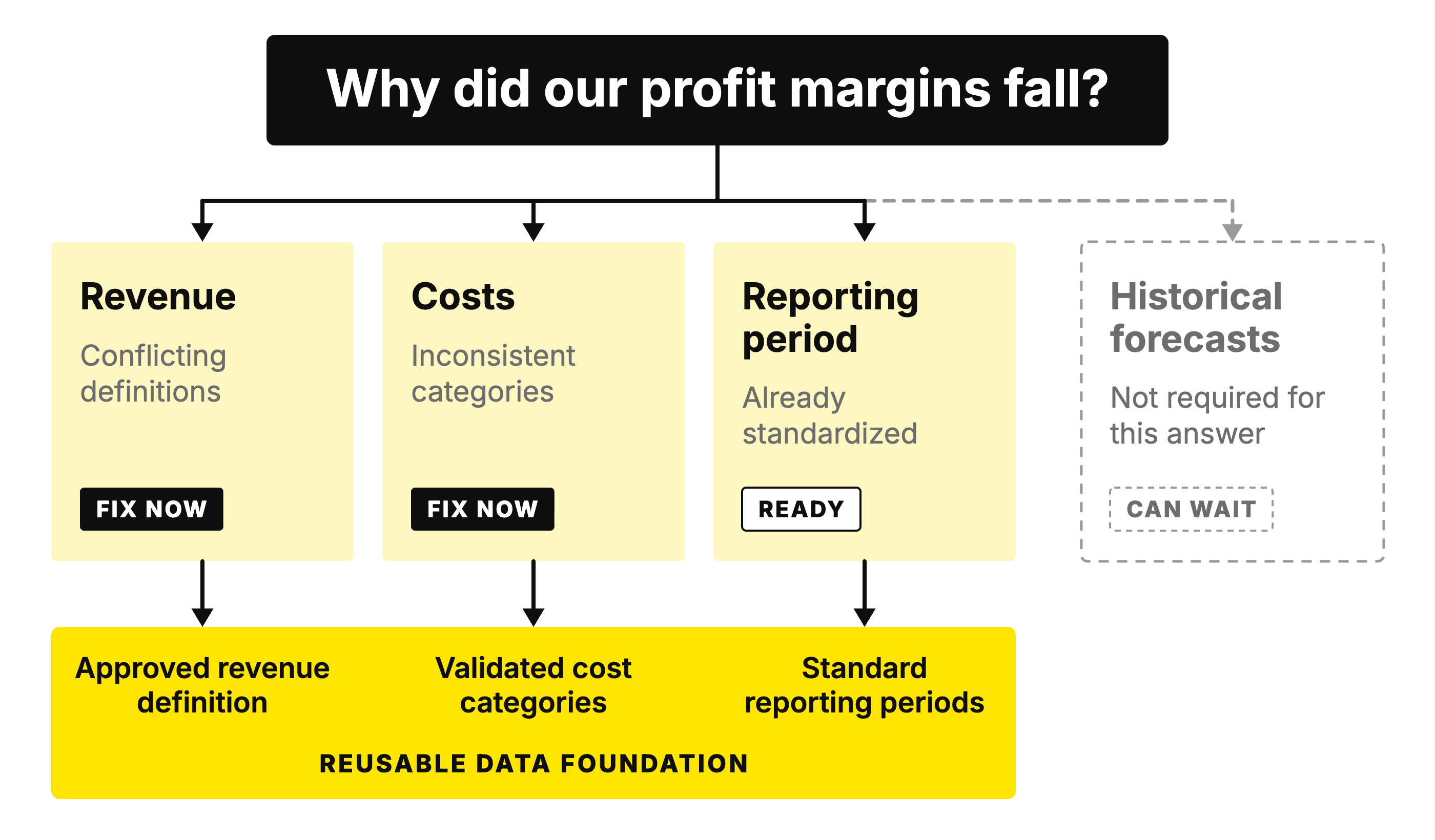
This exercise also helps determine the infrastructure you need. A few dependable integrations may suffice for a small company. A larger organization may need a central store for its structured data, known as a data warehouse, such as Snowflake or Databricks. It may also need shared logic that turns raw records into the tables reports read, known as data models. The choice follows the requirements of the job.
Your AI needs to know what the numbers mean
AI can get the arithmetic right and still reach the wrong conclusion. One system counts revenue when a contract is signed, another when the customer pays, and the costs may cover a different period than the revenue. Avoiding that takes two kinds of written context.
The first is what the numbers mean to the business. Companies need to agree on what each metric means, how it’s calculated, and which records belong together. A shared set of these definitions and calculations, available to people and AI, is known as a semantic layer. Agents can explore freely when little is riding on the answer, but for important decisions they should pull numbers through calculations the company has already approved. An agent investigating the margin drop, for example, can call a tool that runs the approved revenue calculation rather than improvising its own.
The second helps an agent find the right data and read it correctly. To explain the margin drop, the agent has to locate the revenue table and know which date field records the signing and which records the payment. A reference listing every table and field, with what each one holds and its exact format, is known as a data dictionary. Together with the data models behind each table, it gives agents precise definitions down to the individual field. Recording where each table came from, when it was last updated, and who can access it also makes an agent’s answers easier to trace back to the source.
Give agents room to build, but protect the foundation
Agents can help build data models and dashboards, along with the requests that pull data, known as queries. But a change that fixes one report could break others that depend on the same model.
Tenex data engineers have been exploring a separation between two kinds of models: the shared models people depend on, which form a trusted foundation, and a space where agents create task-specific outputs, known as a working layer.
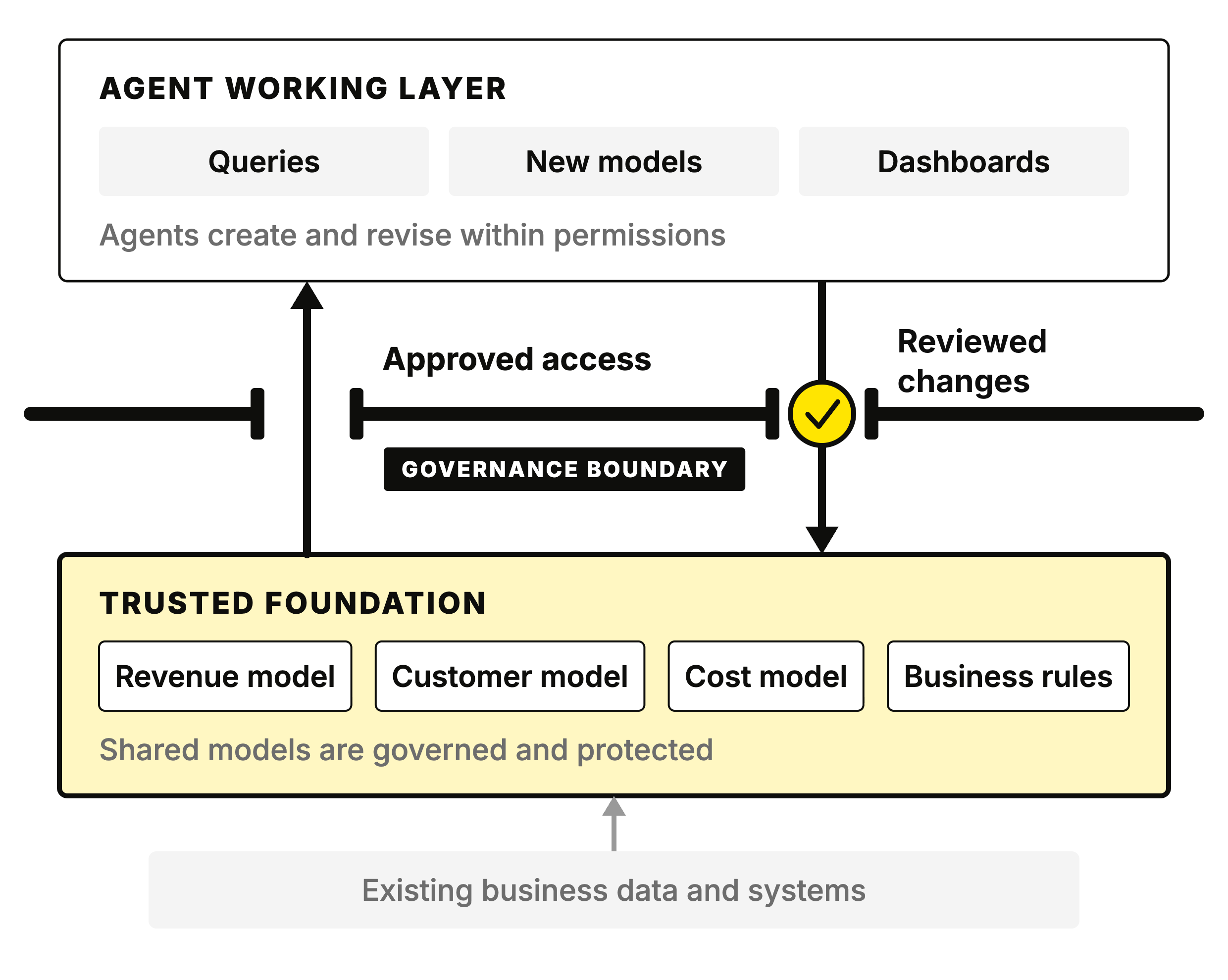
The boundary needs ongoing controls. Low-risk work can pass automated checks; changes affecting shared models need review. Queries should be monitored for performance and cost, and unused models retired only after checking what depends on them.
The people who understand the business need a bigger role
The people who understand what a number means are often different from the people who can change how it’s calculated. AI could close that gap.
Instead of asking an engineer to implement a new business rule, a finance lead could work directly with an agent. The agent would find the relevant data model, propose a change, and test it. The finance lead would review the result, while engineers retain control over the infrastructure, permissions, and safeguards.
Someone who understands the business and uses AI to do work that previously required data engineering skills is what we call a citizen data engineer. It’s a model we recommend, though questions about permissions, testing, and accountability still need to be worked out.
Keeping the data trustworthy
Getting an agent to work once is a start, but data keeps changing, and a definition that worked last quarter may not match how the company works now.
Most of the ongoing checks don’t need AI. Plain scripts can confirm that required fields aren’t empty, that yesterday’s data arrived, that totals match the source, and that dates are plausible. They’re simpler, cheaper, and more dependable than asking another model to inspect the output.
Other checks are about the agent itself: does it answer correctly, and does it say so when its data can’t support an answer?
None of this replaces an owner. Someone still has to correct bad records, approve changed definitions, and answer for each number the agent uses.
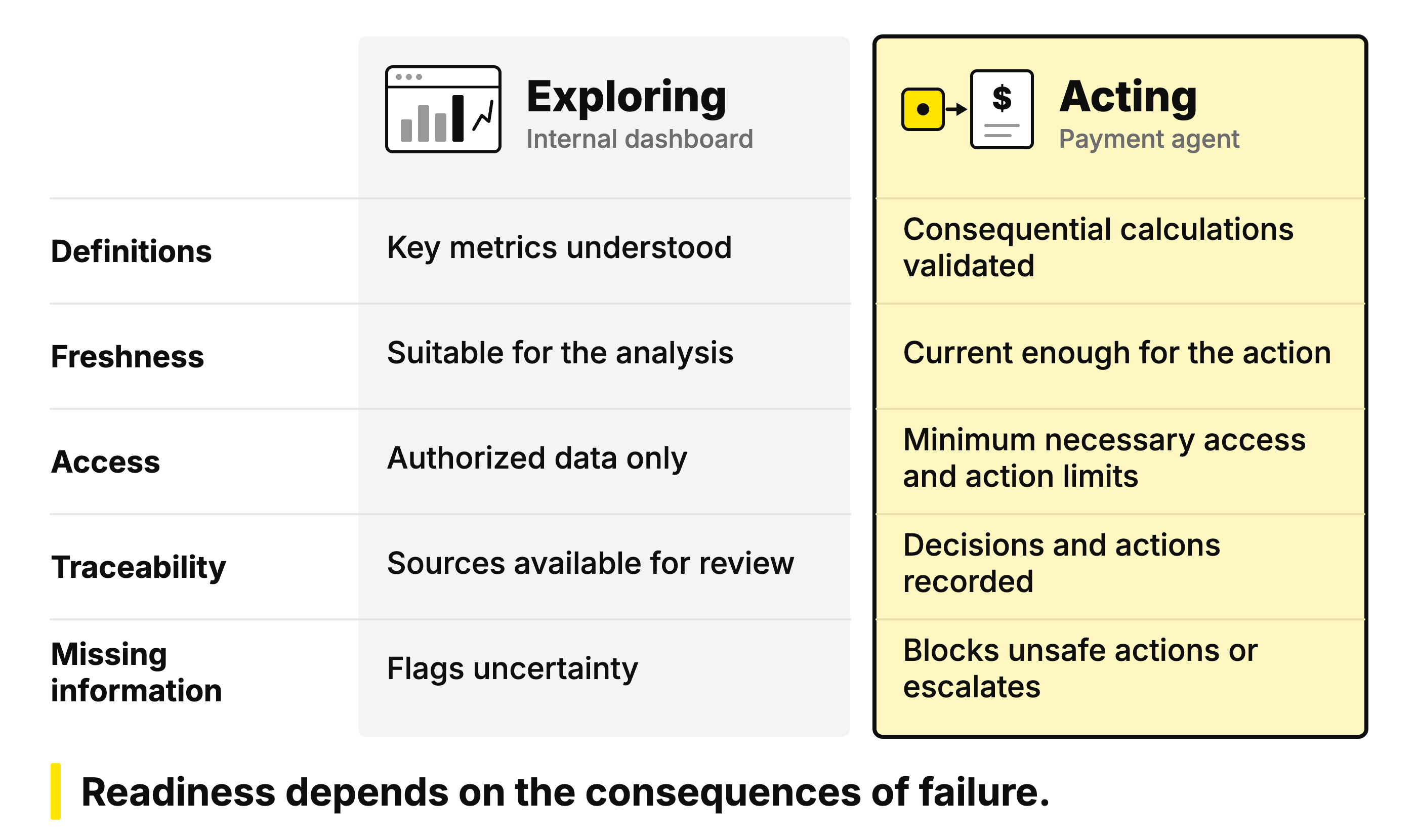
The standard for launching an AI application also depends on the consequences of failure. An internal dashboard used to explore trends and an agent authorized to approve payments need different safeguards.
Make the next AI project easier than the last
Start with a job whose risks you can manage. Build the data models, definitions, and checks it requires, then make that work available to the next application.
As agents take on more of the work of creating queries and models, business experts can take a more direct role in defining and correcting the data they use.
A company often doesn’t need to finish cleaning its data before its first AI application goes live. Done carefully, building AI applications can become part of how the company improves its data.
For more on running AI across the enterprise, read how to measure the ROI of AI, how to set your AI strategy, and how we built an AI-native SDLC. If you want help getting your data ready, get started with Tenex.
FAQs
What is AI-ready data?
Data that a specific AI job can use without guessing. It has an owner, its meaning is written down, an agent can reach it safely, and its numbers can be checked. Readiness is set job by job, not for the whole company at once.
Do we have to clean all our data first?
Not necessarily. It depends on the size of the company, the condition of its data, and what it wants AI to do. Some organizations need substantial foundational work before deploying AI at scale. Others can start with a specific application, fix the data it depends on, and make those improvements reusable.
Do we need a data warehouse?
It depends on the job and your size. A small company may get far with a few dependable connections between its systems. A larger one coordinating dozens of systems usually needs one.
What is a semantic layer?
A shared set of definitions for your metrics and business terms, kept where people and AI tools can both use them. It’s how an agent knows what “customer” or “revenue” means at your company.