We surveyed our team about AI slop: how they define it, how they spot it, and how often they get wrongly accused of it. Here's what they told us.
What our team told us about defining slop, spotting it, and getting wrongly accused of it.
A lot of leaders are having some version of this conversation with their teams right now: We want you to use AI, but just don’t turn in slop. The problem with the directive, however, is that it’s not entirely clear where the line is. In order to better understand the contours of the slop situation, we surveyed our team to understand how they view slop, how they spot it, and what happens when they do.
About fifty people answered, and their responses weren’t entirely predictable. For example, half the respondents had been suspected of using AI for writing they did themselves, and nearly two thirds had changed how they naturally write so it wouldn’t look machine-made. Below, we look at what our team thinks slop is, how they spot it, how suspicion is changing the way they write, and what to do about it.
What we mean
When we talk about slop, we mostly mean bad work that looks like an LLM just spit it out. Nearly everyone said slop is low quality or generic, and more than two thirds said little or no human effort went into it. Only half said “AI wrote all or most of it.” Curiously, three quarters went further: if AI writes something and nobody can tell, it isn’t slop.
That lines up with the definition in our playbook: low-effort, low-quality work presented as authentic and meaningful. What bothers people is being handed something nobody thought about.
What we notice
Effort is hard to see, though, so we look for other things. Nearly everyone flagged repetitive patterns, like everything coming in threes or “it’s not x, it’s y.” About three quarters flagged formatting, long dashes, generic openers, and words LLMs lean on.
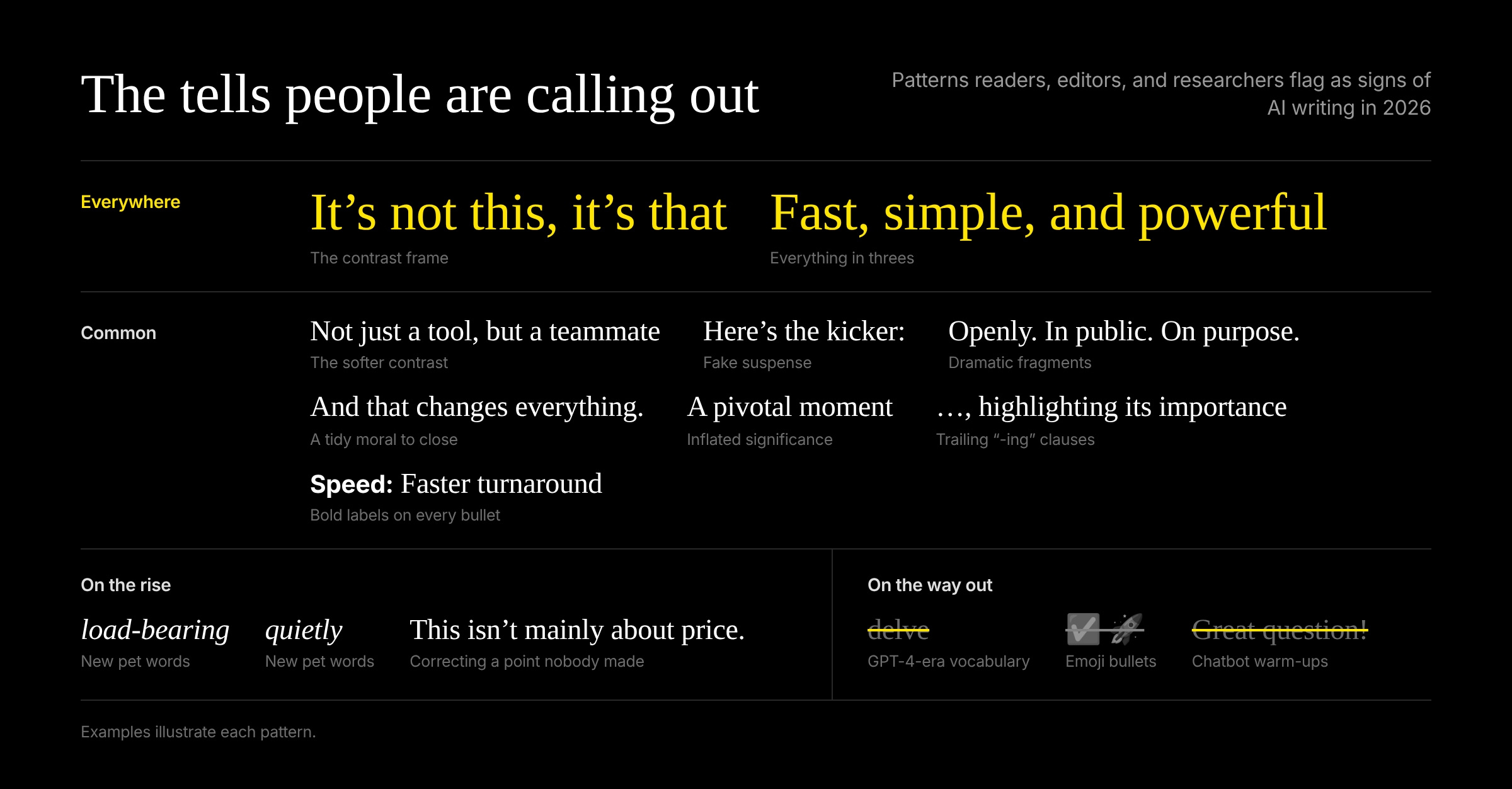
And we generally trust our own radars. Everyone said they were at least somewhat confident they could tell when something was written with AI. Nearly two thirds said they sometimes sense AI without being able to say why, and most of them go with that feeling anyway. Our survey can’t tell us how often that feeling is right.
Why the tells repeat
Anyone who uses these models learns the tells fast, because what shows up in our own chats shows up in everyone else’s. Simply asking for something unique doesn’t reliably produce it. In a funny example, Deana Burke, who posts AI experiments as @wetclaude on IG, asked a model for a unique Halloween costume again and again and kept getting the same handful back. Researchers found the same thing at scale. One model keeps repeating itself, and different models land on strikingly similar answers.
Models learn from what people prefer, and people tend to prefer what feels familiar, so when you ask for one answer, the familiar one tends to win. The same researchers found that asking for several options, each with a rough probability, widened the range. Asking a model to “sound like me” has its own limits. In another study, models given samples of someone’s writing got closer to their style but still drifted toward a generic tone, especially in casual writing.
Everybody is suspect
Two thirds of our respondents have had someone suggest they used AI, and half had it happen when they hadn’t used AI at all. Nearly two thirds have changed how they naturally write to avoid looking AI-generated, and more than a third have experienced both.
That pressure might actually improve their writing. Much of what people associate with AI, from stock phrases to repetitive structures, was bad writing long before ChatGPT existed. If being mistaken for a machine makes people notice and eliminate those habits, their writing may be better for it.
But avoiding suspicion can also become an end in itself. You can remove every recognizable AI tell from a piece of writing without improving the thinking behind it.
What we judge
According to our survey, nearly everyone reacts badly to slop. Two thirds skip the rest and nearly as many assume a lack of effort. Just over half lose some respect for the person, just under half trust them less, and a third are less likely to hire, recommend, or work with them. Those are harsh verdicts, even from those who work in the field. When asked where it bothers them most, people named work email, docs, and chat just as often as LinkedIn.
The pressure to avoid AI tells isn’t necessarily bad. Cutting generic phrasing can improve writing, but you can also remove every tell without adding a worthwhile thought. That’s the distinction behind our eight-question guide.
Ask your own questions
Running a survey like this provides some reasonably valuable data, but the bigger benefit is openly surfacing what your people already think, but rarely articulate. Most of us are making our own judgments; it’s worth considering that everyone else is doing the same (and believe they have a pretty good eye). This gives teams an opportunity to establish expectations together.
Ask what good AI-assisted work looks like, what people expect from one another, and what makes them lose confidence in someone’s work. Talk about the answers. We all use these tools, and it’s far better to agree on what good looks like than to waste time guessing who wrote what.